2/8/09

Naud, Rubin, & Griffiths, Radio Interviews

LISTEN: Lucy Ann Lance Show (from February 7)
"To dam or not. That is the question the City of Ann Arbor, environmentalists, and community recreation groups are considering for the Argo Dam. Matt Naud, City of Ann Arbor Environmental Coordinator; Laura Rubin, Executive Director of the Huron River Watershed Council; and Coach Rich Griffiths of the Pioneer High School Crew Team each weigh in on this controversial issue affecting our Huron River."

COMMENT: posted by Huron River Paddlers
"One point that continues to get lost in the discussions about Argo Dam is that a whitewater paddling community has existed in Ann Arbor for over 40 years. The University of Michigan’s Recreation Sports Program has been the home of the Raw Strength & Courage Kayakers (RSCK) since 1967. RSCK introduces 200 new students and community members to the sport of kayaking each year. Winter months are spent training in the pool at the U of M’s North Campus Recreation Building. In the Spring, new paddlers get checked out on the Huron River. A few locations upstream of Barton Dam allow for the most basic practice of whitewater maneuvers, but these sites are not maintained and are steadily losing their value (after all, they were mill sites over 100 years ago).

Whitewater kayaking is far from a “new group of paddlers,” as some have suggested. Businesses, such as the Kayak Corral in Saline, the Bivouac, and Sun and Snow Sports have catered to Huron River paddlers for decades. New businesses such as REI and Moosejaw do the same. Paddlers from as far as Windsor, Toledo, and Lansing drive to the Huron each Spring and Fall to take advantage of favorable water flows. We support local businesses and feed Ann Arbor’s famous parking meters.

It’s time that whitewater kayakers are recognized as a real, sustaining, and growing user group of the Huron.

2/6/09

Junior Paddler's Letter to City Officials


East Lansing native, Cameron Savage, competing in freestyle kayaking. Age 19

Dear Molly Wade & Matt Naud,

My name is Cameron Savage and I grew up in East Lansing, Michigan. I'm turning 19 this spring and I have been whitewater kayaking for over 10 years now. Kayaking has taken me all over the world. From paddling the warm rivers of Costa Rica, to the mountain streams of the southern US, to my summers working on the Ottawa River in Ontario, Canada, kayaking has always been a part of my life.

I've competed in freestyle kayaking for 4 years, with notable top finishes as a junior in the 2006 World Cup, 2006 US Team Trials and a 2nd place finish in the 2007 North American Championships. This spring I hope to do well in the 2009 US Team Trials, hosted in Glenwood Springs, Colorado. The competition site is a very successful man-made whitewater park completed in 2008. I hope to place high enough to compete in the World Championships this fall.

Whitewater kayaking is an amazing sport. Many people from all over the world participate in the sport, which is eco-friendly and constantly growing. Festivals and Competitions all over the country have attracted international media attention, and there is a large push for the sport to be featured in the X-Games and more prominently in the Olympics. Whitewater kayaking is an extremely safe activity and has many prominent and well-funded bodies ensuring the continuation of this. And although someone who doesn't paddle might not know this, there are hundreds to thousands of people in each state who paddle whitewater every year. That number will grow with the continued granting of access to rivers.

When I started boating at age 8, one of the few beginner whitewater rivers anywhere close to mid-Michigan was the Huron. Through my parents' formed kayaking club, the Lansing Area Whitewater Paddlers (LAWWP), we would take trips down to Ann Arbor to do easy runs for the day. They were very fun and I have a lot of great memories of learning on the Huron. The problem is that once you are able to paddle rivers above the difficulty of the tame section of the Huron that has some whitewater on it, there isn't much else anywhere close to mid-Michigan. The closest mid-level whitewater to here is in Pennsylvania. This leads to difficult issue of being a whitewater boater in Michigan –your choices are very limited.

I've always discussed with my fellow Michigan kayakers the prospect of having a decent whitewater park in the area. They have been popping up all over the country and have become quite popular! Some notable parks that I have been to, and enjoyed, are Watertown NY's Route 3 Wave and Hole Brothers (which have held numerous national and international competitions), Minden Ontario's Wild Water Preserve (which is a beautiful, 7km long man-made whitewater section that has been able to keep an amazingly natural look), South Bend IN's East Race (an epicenter of whitewater sport in the mid-west) and many more.

East Lansing even unknowingly hosts an awesome river feature on the Red Cedar (behind the Library building at MSU), which when the river level is right, attracts paddlers from all over Michigan (I have even been in the local papers twice for surfing the wave there).

Whitewater features are very easy to construct, and man-made features are often constructed as alternatives to dangerous and unnatural dams. Another considerable bonus of whitewater parks is the obvious fact that they bring people to the area. This is great economically and has been proven so by a number of parks in the past few years (i.e. Reno NV, Salida and Pueblo CO, not to mention the US National Whitewater Center in Charlotte, NC). They are also 'cool' and provide a fun way to get people outside and enjoying nature.

When I heard of the possibility of a park in Ann Arbor, all I could think was "brilliant". Ann Arbor is the perfect town for a project like this. It has a large enough community to appreciate it and it's cool and edgy enough to attract boaters from all over. I currently go to school at Champlain College in Burlington, VT. One of the main reasons for coming out here was to be able to kayak more while in school. I found out this year, though, that it is not the right school for me and I am currently in the process of applying to schools. One of my top choices is U of M and the prospect of having accessible whitewater in the area would be a very persuading argument to choose it. The University of Vermont Paddling Club, which I am a part of, has grown so much in the past year, that we can't even accommodate the numbers that flock to our weekly pool sessions. Freestyle kayaking or 'playboating' is becoming increasingly popular with people my age and it is a very cool and easy sport to get into. All we need is one, natural looking, retentive feature, that is easy to access and maintain at many water levels. This appeals to boaters of every skill levels, from first-time beginners to full on professionals.

I am very excited for future of this project in Ann Arbor. As the word gets out, you will notice that many whitewater boaters also feel the same way. Michigan could become a state that is desirable for whitewater, and this is the first step. If you need any more information or help in regards to the project, contact me. Please seriously consider the possibility of a whitewater park. It will make more of an impact that you can imagine.

Sincerely, Cameron Savage

2/4/09

Matt Naud on WEMU, 89.1 Ypsilanti


Issues of the Environment
Bob Eccles
YPSILANTI, MI 2009-02-04 Listen to this week's Issues of the Environment from WEMU, featuring Ann Arbor's Environmental Coordinator Matt Naud, who discusses what's involved in balancing recreation with environmental issues on the Huron River.

1/29/09

Row, Baby, Row


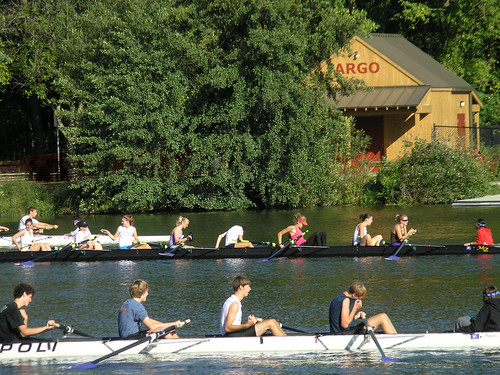
An organized and pre-scripted group of Ann Arbor rowers dominated the first of three public information sessions hosted by the City of Ann Arbor. As http://www.huronriverpaddlers.blogspot.com/ followers know, these meetings are designed so the public can comment on the future management of Argo Pond, Argo Dam, and the Huron River as it flows through downtown Ann Arbor.

Wednesday night's session, however, was not a session where public comments could be shared freely.

The meeting facilitators--members of the Huron River and Impoundment Management Plan (HRIMP) Committee--attempted to manage breakout sessions devoted to three management options: total dam removal, a hybrid dam replacement with downstream whitewater, and repair of the existing dam infrastructure. Session attendees were asked "what do you like," "what are your concerns," and "what would you do differently." About 50 people, a mixture of high school students, parents, coaches, and Ann Arbor residents, attended each session.

But only the members of the rowing community could be heard.

"Can't you walk somewhere else?" was the response of one student rower reacting to resident's concern that bullhorns and motorized activity associated with rowing are a disturbance during his strolls along the impoundment. Rowing enthusiasts instigated a discussion about the possibility of toxins, like Mercury, that may reside in the ever-increasing sediment build-up behind the dam, suggesting that dam removal would force the community to face a potential toxic clean-up. One rowing parent could not understand the need for restoring the river's natural function--to move water and carry sediment, something that dams prevent. A rowing coach argued that removing the dam would result in less public access to the Argo stretch of the river.

While the supporters of rowing made statements that devalued other forms of recreation, suggested that toxins left alone will never be a problem, and argued that an estimated 27 acres of new park lands would result in fewer opportunities for public access, many non-rowing voices went unheard.

The sad reality facing wading anglers, bicyclists, birdwatchers, walkers, joggers, and swift water paddlers is that there is no data to support that restoring riparian corridors along the Argo stretch of the river would result in greater use by these groups. In fact, the only data the City has used to evaluate recreation on the river resulted from the following: an online "angler survey" (less than 300 respondents), City canoe livery figures, and information directly from the rowing community.

Paddlers, I urge you to attend the remaining two public meetings and to share what you like about the proposed plans, what your concerns may be, and if you think the City needs to take a different approach. The HRIMP Committee members are eager to hear your voice.

Right now, all the Committee members are hearing is "row, baby, row."

1/26/09

From the Watershed Council

You have an opportunity to help the Huron River

You have an opportunity to help shape the management and direction of the Huron River as it flows through Ann Arbor. And we need your help. We have been working with the City of Ann Arbor to develop strategies for managing and protecting the river in Ann Arbor with a focus on the dams and their upstream impoundments. These impoundments are struggling with a build-up of sediment, nuisance weed growth, algae blooms, poor ecologic quality, and multiple recreational uses. The city has not had dedicated funds or a strategy to manage these uses and problems.

Following a 1995 DNR Huron River Assessment, the Huron River Watershed Council believes that Argo dam doesn’t make sense any more. The restoration of the river should be a priority and removing this dam is the most sensible option. Argo dam's infrastructure is aging and requiring large investments (exceeding $0.5 million dollars). The build-up of sediment and weed growth is a problem for recreational users and the rowers now weed whack (mulch) the plants in order to cut a path to row. Rather than managing all of the impoundments for all uses, active recreation and public funds should be focused on fewer impoundments where the City can dredge, manage weeds, and serve the public.

The city is hosting 3 public meetings over the next 2 weeks. The environmental commission will hear and vote on the recommendations in March and April and then they will go to the City Council for approval.

Here are the public meetings and times and the primer. If you can make it to a session and express your thoughts, great and thank you. I am also working with other interest groups to get more voices at these meetings.

Public Meetings:
1/28 7-10pm
1/31 9-12 noon
2/5 7-10 pm


The Primer is posted on the HRIMP website under background documents

Please feel free to share

Public Meetings Link

If you have further questions, please contact me at lrubin@hrwc.org.

Thank you,
Laura

1/15/09

Public Meeting Dates, Times, & Location

Forsythe Middle School
1655 Newport Road
Ann Arbor, MI

Google Map

January 28th (7-10pm)
January 31st (9-12 noon)
February 5th (7-10pm)

1/12/09

Picture This! Ann Arbor Whitewater


In November 2008, the City of Ann Arbor received a report from the industry-leading designer and installer of whitewater features--Recreation, Engineering, & Planning (REP). To learn more about REP, you can visit their website: http://www.wwparks.com/.

The report from REP to the City is now available for download. Everyone is encouraged to review this document in advance of the planning sessions on January 28, January 31, and February 5.

1/7/09

City Plan for Managing the Huron River

IMPORTANT UPDATE. PLANNING DOCUMENT NOW AVAILABLE

The Huron River and Impoundment Management Plan Committee has developed a background document for public review prior to the Public Meetings.

Please download and review this document TODAY!

1/2/09

Kayakers Use the Huron Year-Round

Photo: Jim Malinowski
January 1, 2009 - A dozen members of the Raw Strength & Courage Kayakers club conducted the 33rd Annual New Year's Day Paddle on the Huron River.

Full coverage of the event can be found here: New Year's Day Paddle.

River levels remain high following an after-Christmas warming period, providing both challenging and enjoyable conditions between Zeeb Road and the Delhi Metropark.

Note: kayakers and canoeists should be well-dressed for the elements one encounters when embarking on a winter paddle. Dry suits, dry tops, non-cotton insulating layers, and spare clothing are only a FEW of the must-have items for kayaking the Huron River in winter conditions.

12/19/08

Background Documents on Argo Dam

The City of Ann Arbor has updated the online availability of resource material for studying Argo Dam. Please visit the following website and familiarize yourself with the information provided:

Background Documents

Of note are maps of the impoundments, a hydro-power feasibility study, and a summary of dam removals in Michigan. This page is regularly updated by the City and will continue to provide paddlers with new information regarding the future of our river and Argo Dam.

Please remember to mark you calendars for the public meetings in January and February. To date, locations for these meetings have not been set, but all will take place in Ann Arbor.

12/4/08

Public Meeting Dates Announced

New Year's Day Paddle 2008 - Photo: Dan Lehner

The City of Ann Arbor will hold public meetings to discuss changes to Argo Dam, future management of the Huron River, and a proposal from the firm Recreation, Engineering, and Planning. The meetings will occur on the following dates:

- Wednesday, January 28, 7 - 10 pm - Location: TBD

- Saturday, January 31, 9 - 12 am - Location: Cobblestone Farm

- Thursday, February 5, 7 - 10 pm - Location: TBD

It will be essential for members of the local paddling groups--especially RSCK, EMU, and LAWWP--to attend these meetings. Your help is needed to raise awareness for the sport of whitewater kayaking and to show support for new, sustainable whitewater resources in Ann Arbor. Participation in whitewater kayaking continues to grow, but few people know that the paddling community in lower Michigan has used the Huron for practice and training for over 40 years! Now we may have the opportunity to paddle close to home, improve our river's ecology, and share our sport with hundreds of new paddlers. Stay tuned for more details, including locations for the evening sessions.

12/1/08

Watershed Council Director on Dam Removal

In the Winter 2008 edition of the Huron River Watershed Council's quarterly newsletter, Executive Director Laura Rubin provides an update on dam removal. Citing the 1995 DNR Fisheries study that prioritizes dam removal in the Huron River Watershed, Rubin writes about two local dams, Dexter and Argo:

Neither of these dams provide hydropower, nor do they serve as flood control dams. They are operated as run of the river, which means that what comes in goes out (like a big bathtub). Rather than help control or minimize flooding, these dams are greater safety hazards as they age. If they fail, they potentially could flood residents and businesses downstream.

The Dexter Dam was removed in 2008. A member of the local paddling group, the Raw Strength & Courage Kayakers, describes his "first descent" of the now free-flowing tributary:

Approaching the former dam site, there are several small riffles, one with a mildly surfable wave at this water level. The former dam site itself has a small ledge drop, best run on the center left (very shallow to the right). It can be side-surfed, and those with short playboats might even get a flat spin in it. My RPM was too long, though. From there it's flat water to the Huron, and take out wherever suits (I went on to Dexter-Huron Metropark).


Mill Creek after dam removal - Dexter, MI


Argo Dam is the next candidate for removal. The dam and its adjacent embankment (an earthen extension of the main structure) represent a growing maintenance headache for the City of Ann Arbor. Removal or modification of the dam could create an opportunity for whitewater kayakers to have a new practice and training facility on the Huron River. Installing whitewater features will lead to positive environmental changes for the river--increased aeration, fish passage, and sediment-trapping. However, any drastic change to the water levels in Argo Pond will ultimately displace the well-established rowing community. HRWC's Rubin writes:


We want to keep the rowing in the City of Ann Arbor, but find another impoundment for rowing. Balancing the needs of the rowing community with the ecological and economic benefits of removal is the tricky part of this drama.

As fellow watermen, kayakers should support Rubin's statement. Rowing is an important part of the community--just like kayaking--and rowers deserve to continue using the Huron to practice and train for their sport. However, diversifying the recreational opportunities on the river and providing positive environmental changes are two major benefits of removing Argo Dam.

Kayakers and rowers alike will have the opportunity to comment on the City's plans for Argo Dam, beginning in January 2009. Stay tuned for announcements about meeting locations and times.

See you on the river!